Setting Your Curriculum Intentions for Home Education
Re-turning within to uncover the emerging path of learning

I’ve been setting New Year intentions for myself for well over a decade now; and I’ve seen how powerful it is to align your thinking and hone your goals – and the outcomes that come out of the process. So it was a natural progression for me to extend this ‘intention setting’ process and to use it to set my child’s intentions for the year ahead – which can’t help be relevant for home education.
There are many ways to approach this task, and in this article we will explore some of the principles and the methods you could use. However, as ever – and particularly with a Home Educating lifestyle – it is imperative that you consider and find what works for you and your child and worry less about comparison or relativity to others.
Purpose of Setting Intentions
The purpose of taking considered and sacred time to set intentions for personal growth and development; so this naturally extends to learning in the traditional academic sense. The beauty of this gentle activity, which allows yourself the freedom and space for stillness and reflection, is that it provides a platform for a holistic view of your life. When applied from a Home Education perspective, it allows you to consider all the aspects of your child’s life, learning and their dreams, goals and areas for growth. It gives further credence and importance to the process, and as a by-product, the resulting actions, decisions, choices and steps you take.
It allows you to shift learning from a passive and rote style, to a focused or targeted approach that organically arises out of your child’s existing path. As a parent, it allows me the chance to reflect on what are the priorities – and to filter that down further (if necessary, and potentially as a slight aside to the activity) to financial, time and resource obligations and priorities.
For the child, it allows their true passions and flare a forum to be honoured – whilst also giving space to consider the things that perhaps they don’t feel confident or strong enough in.
Deciding Categories
There are as many different ways to split your ‘life’ up into categories, as there are different lifestyles… So finding the format that resonates best for you, is really important. The purpose of this is to enable you to put each aspect under the microscope, ensuring you give an honest and balanced analysis of the current position. It’s easy to otherwise find yourself with extended focus on certain aspects of learning, and then becoming overwhelmed with others that haven’t had the same attention. Without those anchors that ‘speak to you’, it’s more likely that the process won’t be completed to it’s fullest.
The categories I use, which I saw on a You Tube video by a Yoga teacher, are as follows: 1) Lifestyle and Livelihood; 2) Body and Wellness; 3) Creativity and Learning; 4) Relationships and Society; 5) Essence and Spirituality.
1) Lifestyle and Livelihood – this category focuses on the stability, security and grounding aspects of life. As an adult it relates to my work, sense of financial security and stability. Perhaps if a teen HE student, there could be aims here to gain work experience in a particular field. For younger children, it may be developing independence outside of the home environment. It could also relate to pocket money (if your family do that), taking responsibility for their environment (i.e. their bedroom, or a wider household impact); budgeting and learning about money from denominations, to currencies and exchange rates, to planning finance or accounting for a business idea.
2) Body and Wellness – this is easily relatable to physical and mental health and nutrition. It could relate to learning to swim; ride a bike without stabilisers; journal more to promote mental house-keeping; eating more fruit and vegetables; or for the other end of the scale - achieve that ‘black belt’ in karate or compete for Olympic positioning! It can be about learning about their own biology and using that knowledge to better their own health and wellness.
3) Creativity and Learning – this is such a wide one that speaks to me of art and inspiration; so it is key to hone in on your child’s loves and interests. Have you got a tiny ballerina, who can’t stop dancing? Does your child play the drums on every surface in your home and needs a more structured output for this inclination? Perhaps you have an incredible artist – who’s desperate to try a new medium? As well as the areas that perhaps they would benefit extension and challenge in – such as those fundamental aspects of reading, writing and maths. Problem solving would also come here.
4) Relationships and Society – we’ve all heard the age-old fear of home education leading to a lack of socialisation of children. This is the chance to really put your child under the microscope on this, and review if and how they could grow in this area. Family, relationships, friendships, teammates, how they approach serving others and the wider community.
5) Essence and Spirituality – finally this encompasses all the aspects of a person, that don’t neatly fit in the typical school-driven curriculum… perhaps your family have a faith that you follow, and this may find identity here. Otherwise, morality, higher thinking, purpose and resilience will likely be relevant for most on the path of learning.

These categories, however, are just ones that I use – but on considering this article, I pondered on other examples and how I might use them, such as:
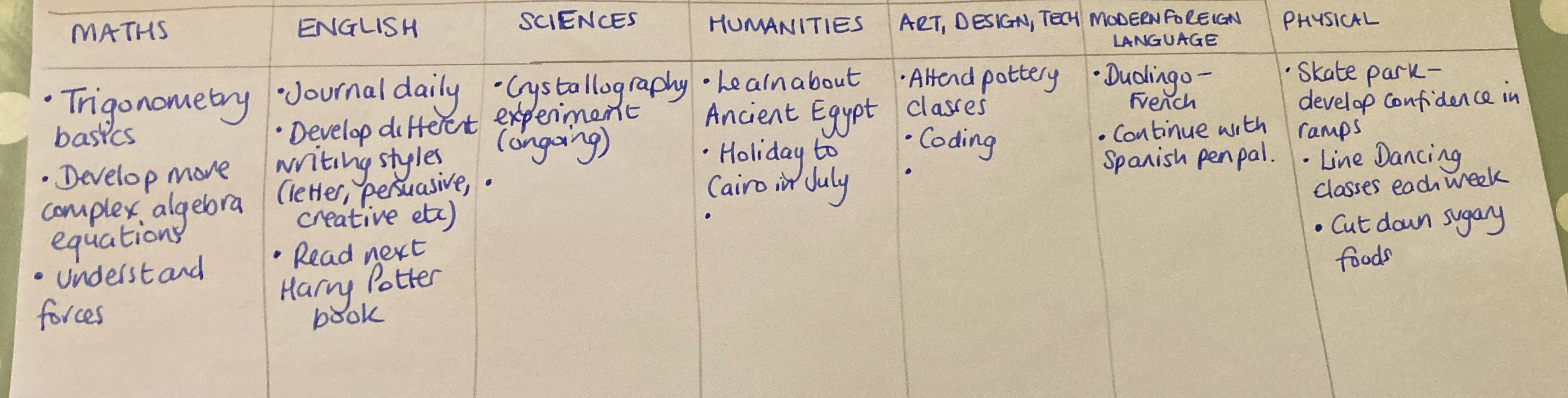
Traditional National Curriculum subjects – if you tend to follow a more structured approach to learning, mirroring or parallel to the National Curriculum – then this may feel most appropriate for you. Splitting your table into subject areas such as Maths; English; Sciences; Humanities (History, Geography, Religious Studies); Art, Design and Technology; Modern Foreign Language; and Physical Education. One word of caution on this is that I felt it could be easy to list every subject and feel utterly overwhelmed at the outset – but by grouping, and recognising the ever-connecting threads each area has to others; it’s easier to see how to facilitate learning across all areas to promote a broad and balanced curriculum.
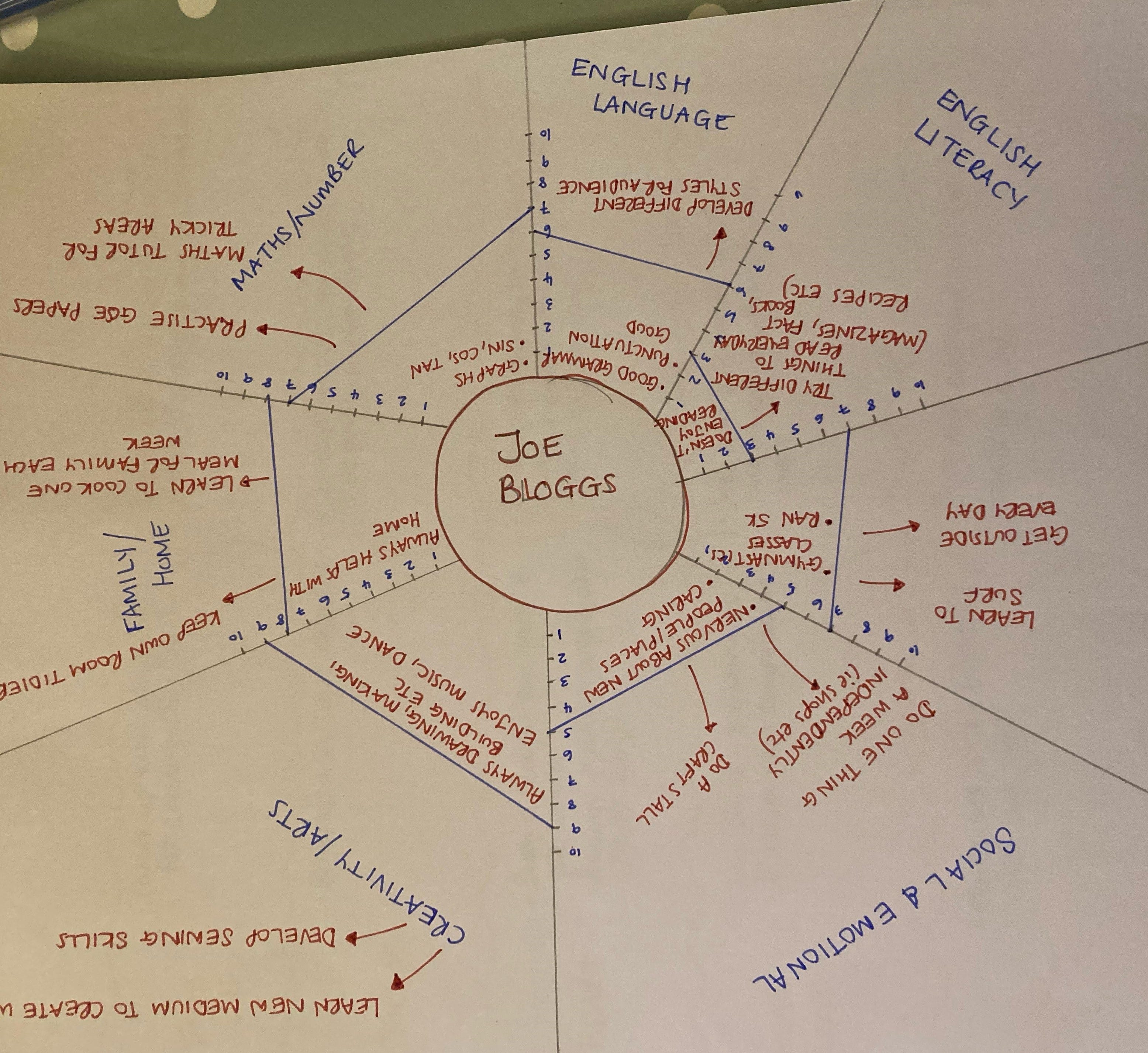
The Wheel of Life – this typically asks you to rate, on a scale, areas of your life and how they currently feel. It’s a really powerful way of showing, visually, perhaps imbalance on areas that need more time or development on; and those that you are flying in!
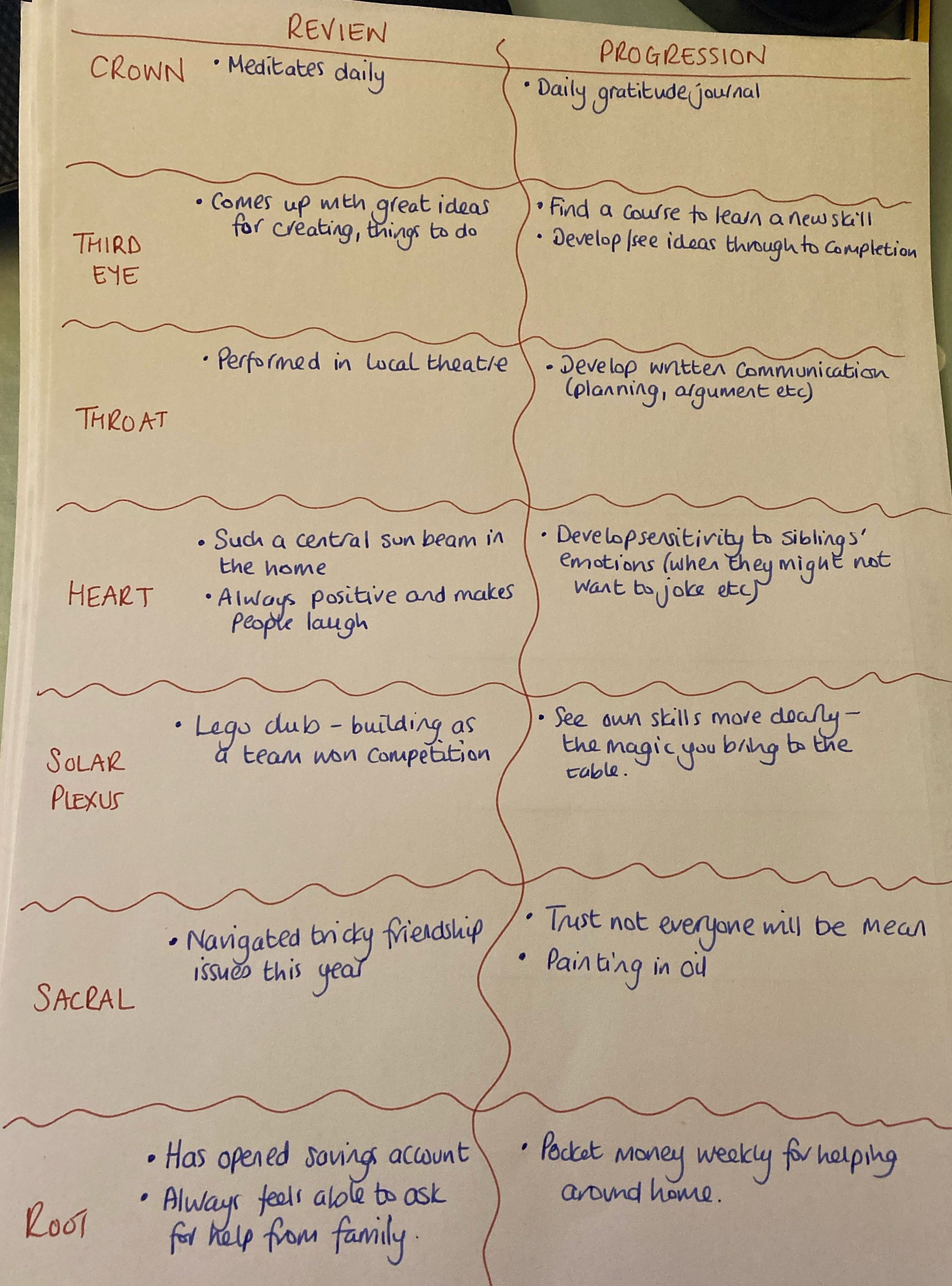
Body Energy Centred Approach - i.e. Chakras – Root (stability, security); Sacral (emotion, joy; relationships; creativity); Solar Plexus (Intellect; self-worth; teamwork); Heart (compassion; love; support; family and home); Throat (communication; expression; organisation; integrity); Brow or Third Eye (self-responsibility; inner strength/resources) and Crown (spirituality; connection).
This one would take more time to consider it in terms of education, but it’s a valid way to ensure you are developing balance across their experiences.
Starting by Looking Back
Once you have decided what categories you are going to use, it is incredibly powerful to start the process by reviewing the categories for the past year. It is amazing, even if you’ve never done this process before, when you stop and consider the person your child was a year prior (or whatever ‘review’ point you want to apply) and who they are now; and all the iterations of learning, growth and change that have happened in between. Perhaps they’ve appeared in their first on-stage performance; or won a Lego building competition; achieved a qualification through night school or completed online modules to learn a language; mastered number bonds 1-20; read their first chapter book independently; had a new sibling – or perhaps lost a loved one… all valid, all experiences to be integrated within their learning.
And it’s important to give yourself, as well as them, the recognition for what’s been achieved thus far. Because – and this is crucial – you, as the parent, are the one who creates and enables the opportunities for learning. It’s very likely that you finance the things that your child takes part in; provide transport or resources. You are critical and integral to their successes – even if they are independent learners who drive their own interest-led learning each day.
Looking Forward
Lastly, it’s time to look at the areas for the year ahead. This is where the review becomes so useful, as you’ll find natural progression steps fall into place – and gaps become glaringly obvious.
Depending on age, it’s important to include your child in the planning ahead as well – or even get them to do their own version if they are old enough. While it’s not about putting ceilings on their learning, you play a key role in managing expectations and practicalities – but also in fostering that aim, ambition, hopes and dreams. This isn’t about highlighting all the areas you feel they are lacking – it’s about listening to their journey, whatever age they are, and identifying realistic areas for progression, growth, improvement, skill and confidence-building.
Once this process has been done, I usually feel a few key words emerge and they form my year’s priorities or mantras to bring me back in alignment with the intention set as a result of the exercise – such as ‘growth’, ‘create’, ‘movement’ and so on.
Lastly I put all of this down on one sheet and display it somewhere that I see daily, and this serves as a great prompt and motivation for moments of inertia.
Because as a home education family, you aren’t bound by the academic timetable necessarily, you can also choose the appropriate time to do this activity for the ‘start’ of your year. Whether that is for 1st January or 1st September, or any other date in the year. It also lends itself to whatever review points you want, if you want them – monthly, termly, bi-annually or annually…
Last Thoughts
Overall this is intended to be a positive, heart-warming and motivational activity. It will hopefully deepen your connection to your child, and you may find you identify different approaches suit your children differently. Equally, I have found as my children age, that the way we choose to set intentions changes and grows with us as a family.
This isn’t a process to get bogged down in, end up feeling fearful or unsuccessful in – and you’ll hopefully see how, even at points when it can appear learning focus has taken a break, your child is still attuned to deep learning and reflection – leading to overall tangible changes.
It’s an opportunity to stand back and see the extensive learning Home Edders engage with in all aspects of life, from the traditional classroom based topics to the less prescriptive side of learning such as building those qualities or tools needed to manage the ebb and flow of life.
We’re planning to homeschool when our kids are school-age, and I love the framework this invites. I imagine, too, that these categories help answer questions or “filter” if you’re ever at a crossroads or big decision. Thanks for sharing!
I love that these categories reflect educating the “whole child”! I do something similar to guide our intentions - starting with core values and working outwards from there. 😊